
Бесплатный фрагмент - Passenger automobile transportation economics and organization
Textbook
1 PASSENGER AUTOMOBILE TRANSPORTATION ECONOMICS AND EFFICIENCY
The economy of passenger automobile transportation is a system of interrelated processes that ensure the viability, sustainability and development of transport services. It combines the costs of maintaining rolling stock, staff remuneration, traffic management, maintenance, infrastructure and information systems, as well as management decisions related to tariffs, contracts and the distribution of financial responsibility between the carrier and the customer of the service. The main objective of the economic model is to ensure the availability and quality of transportation with a rational use of resources, avoiding situations where network expansion or increased output leads to a disproportionate increase in costs without improving the actual mobility of the population.
The basis of economic sustainability is the cost structure of the carrier. The most significant elements are fuel or energy costs, salaries for drivers and support staff, maintenance and repair of rolling stock, purchase of spare parts and operating materials, infrastructure maintenance, insurance, depreciation and rental of rolling stock. A significant part is taken up by indirect costs — the organization of dispatching control, driver training, updating information systems, data processing, security, and sanitation. The change in the cost structure is directly related to transportation technology: for example, increasing the intervals at night reduces operating costs without compromising quality, and the organization of dedicated lanes reduces fuel consumption by reducing traffic jams and making traffic more regular.
Economic decisions are inextricably linked to the specifics of demand. Stable rush hours require heavy output, while off-peak periods allow for reduced traffic intensity. It is important to understand that each additional bus on the line brings a double effect: on the one hand, the intervals are shortened and the attractiveness of the service improves, on the other hand, the direct costs of fuel, labor and equipment wear are increasing. Therefore, the optimal distribution of output is based on an analysis of the actual occupancy and time budgets of passengers. With high variability in demand, it is advisable to switch to adaptive schemes: shortened revolutions, efforts in areas of increased load, redistribution of equipment within shifts, and the use of rolling stock of different capacities depending on the time of day.
Tariffs and financing models play a special role. In urban transport, the fare is more often fixed and does not reflect the full cost of the trip, since a significant part of the costs is covered by the budget of the region or municipality. This is justified because transport performs an important social function and has an impact on the city’s economy: it provides access to jobs, educational and medical institutions, reduces the burden on the road network and reduces environmental costs. In suburban and intercity services, the share of the carrier’s own income is usually higher, and the tariff policy includes a system of benefits, discounts, tickets for several trips, season tickets and dynamic models for online sales. In conditions of high operating costs and limited purchasing power of the population, transparency of tariffs, clarity of rules and predictability for the passenger are important.
Contractual service models make it possible to link economic incentives with the quality of work. The municipality or region enters into an agreement with the carrier, which sets out the mandatory indicators: the regularity of flights, the observance of intervals, accessibility for passengers with limited mobility, cleanliness of the cabin, compliance with schedules, informing passengers. The fulfillment of the indicators is confirmed by navigation and ticket system data, and deviations lead to lower fees or fines. This model makes quality measurable and financing predictable for the carrier. In some cases, a “gross model” is used, in which the customer receives revenue from the tariff, and the carrier receives payment for the amount of work performed — this allows flexible schedule changes without risk to the carrier. An alternative is the “net model”, where the carrier receives tariff revenues and bears the risks of demand; this scheme is used where passenger traffic is stable and high.
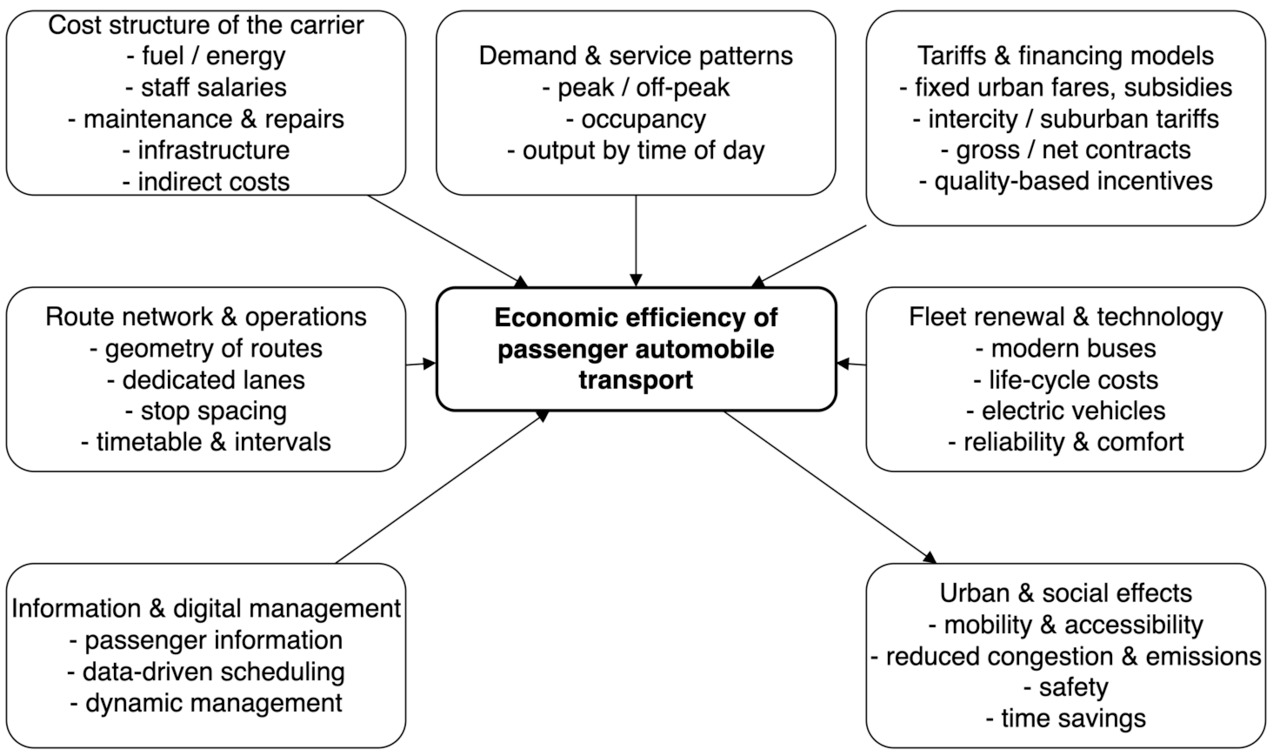
Economic efficiency is closely related to the renewal of rolling stock. Modern buses are characterized by lower fuel consumption, improved maintainability, longer durability and better conditions for passengers. However, their acquisition requires significant investments, which are either funded by the budget or compensated in the contract. It is important that the fleet renewal cycle takes into account not only the initial cost of equipment, but also the life cycle: the cost of fuel, repairs, spare parts, downtime in repairs, and service life. Often, a more expensive bus turns out to be economically more profitable in the long run due to lower operating costs and greater reliability. An additional effect is provided by the use of electric vehicles: despite the high start-up costs, it provides low operating costs, reduces noise and emissions, but requires a well-developed charging infrastructure and a competent charging schedule.
Geography and organization of the route network play an essential role. Straight-line routes, a small number of “broken” sections, fewer left-turn intersections, and optimally positioned stops can save time and fuel, improve regularity, reduce the likelihood of failures, and reduce the need for backup. On the contrary, complex and confusing routes, frequent deviations, congested intersections and excessive density of stops lead to increased costs and a deterioration in the quality of services. Therefore, the economic analysis of the route includes an assessment not only of passenger traffic, but also of the geometry of the streets, the technological performance of the timetable, the need for additional units of rolling stock and the impact on adjacent lines.
Economics is closely linked to the quality of passenger information and flow management. A passenger who understands where and when to go chooses a route without unnecessary mistakes and delays. This increases the attractiveness of public transport, increases demand, and reduces hidden system costs, such as those caused by overloading of individual lines when others are underloaded. Digital services make it possible to adjust schedules based on actual data, predict the load and redistribute the manufactured rolling stock in advance. In the future, this allows us to move to dynamic management models, where economic efficiency is achieved by reducing “dips” between peak periods and timely strengthening of the busiest areas.
The economic effect extends not only to the carrier, but also to the urban environment as a whole. Improving the regularity and speed of movement reduces the use of personal vehicles, reduces noise, emissions, increases road safety and saves residents time. These intangible effects, although difficult to include in a direct cost calculation, account for a significant portion of the public benefit. Therefore, when evaluating the effectiveness of transport projects, not only direct costs and incomes are taken into account, but also changes in the quality of the urban environment, increased availability of jobs and social services, reduced travel time, reduced traffic jams and improved patterns of movement of the population.
The economic sustainability of passenger transportation is achieved through a combination of rational network design, flexible traffic management, sound tariff policy, contractual incentives, and thoughtful fleet renewal. These elements form a single system that allows you to maintain a balance between the interests of passengers, the capabilities of the carrier and the financial capabilities of the municipality. In the context of urban growth, changing demand patterns and increasing quality requirements, the transport economy must rely on data, transparency and forecasting, ensuring sustainable development and increasing the attractiveness of public transport.
2 INFORMATION SUPPORT AND INTERACTION WITH PASSENGERS
Information support in passenger automobile transportation is as much an obligatory element of the service as rolling stock, route network or timetable. The passenger makes a decision about the trip, chooses a route, evaluates the travel time and the risks of delays based on the information they receive before the trip, on the way and at the time of transfer. The quality of this information depends not only on convenience, but also on safety, as well as the actual attractiveness of public transport compared to a private car. Interaction with passengers includes not only the transfer of information “from top to bottom”, but also feedback: complaints, suggestions, fixing problems that allow you to adjust the organization of traffic and improve the quality of the system as a whole.
Information related to transportation is conventionally divided into several levels. At the strategic level, it is important for passengers to understand the overall network structure: which areas of the city and suburbs are served, where the main transfer hubs are located, what types of communications exist and how they are interconnected. At the tactical level, interest is focused around a specific route: the route layout, the list of stops, the line’s operating hours during the day, approximate intervals during different periods of the day, and service features on weekends and holidays. At the operational level, it is crucial to answer the questions “when will the next bus arrive”, “are there any delays” and “what to do in case of a malfunction”: this requires current, frequently updated information about the actual movement. Along with this, a layer of regulatory information is important: the rules of carriage, requirements for behavior in the cabin, the procedure for using benefits, the conditions for refunding funds, and the specifics of transporting hand luggage and baggage.
The placement of information in space and time should correspond to the logic of the passenger’s movement. Before leaving home, he usually chooses the general scheme of the trip: at this stage, electronic maps, route search services, timetables in a convenient format, and the ability to estimate travel time in advance, taking into account transfers, are in demand. When approaching a stop, clear signs, mnemonic diagrams and visual timetables are needed, allowing you to effortlessly determine the right line, direction of travel and estimated waiting time. At a stop, there should be enough information for a person who is not familiar with the system to be able to make a decision on their own: where a particular route takes, what interval should be expected, and where it is more convenient to transfer. Inside the bus, the information is supplemented with the names of the current and next stops, a reminder of safety rules, an indication of places for people with limited mobility, and information about the possibilities of transferring to other lines.
The clarity of information is of particular importance. Even if there is a large amount of data presented in complex language or small print, the practical benefits may be minimal. Therefore, when designing schedules and schedules, the main principle is accessibility for perception: large, readable font, contrasting and non-aggressive colors, logical grouping of routes, understandable symbols. Diagrams should not copy a geographical map with excessive detail.; It is enough to convey in a simplified form the location of the main streets and lines, with an emphasis on the connections between districts and transfer hubs. Consistency is important: the design of different stops, buses, and official information materials should follow a single style so that a passenger, having learned the rules of reading the diagram in one place, can easily apply this experience in another.
Information support should take into account the needs of people with different perceptual abilities. For passengers with visual impairment, voice announcements of stops, tactile signs at bus stops, contrasting designations of doors and handrails are necessary. For people with hearing impairments, light displays are required that display the names of stops, route numbers, and important messages. Simplicity of language is also important: avoiding complex phrases, unnecessary abbreviations and special terms that are not understandable to a layman. Information about the rules of transportation and safety should be presented in such a way that it can be understood by a person without special training, including teenagers and elderly passengers.
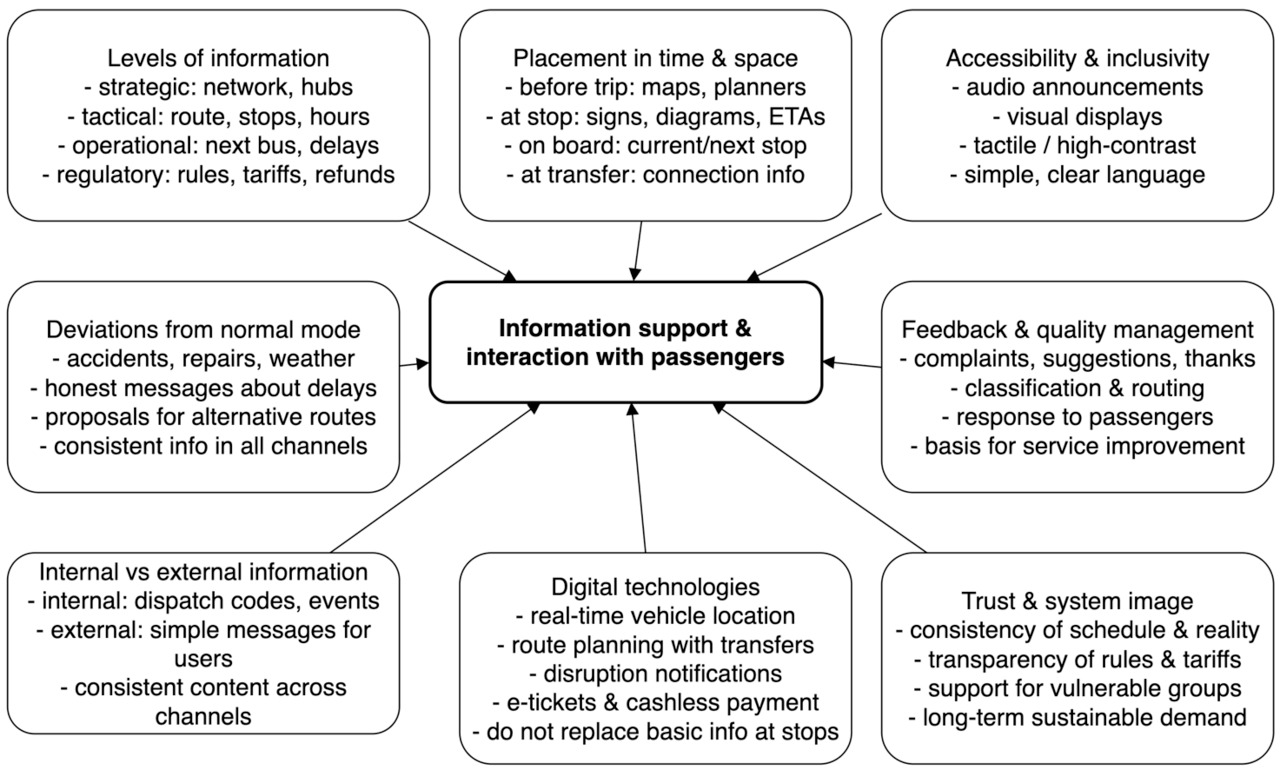
A separate area of information support is dealing with deviations from the normal mode. In real conditions, traffic is inevitably disrupted due to road accidents, repairs, adverse weather, mass events, and technical malfunctions. In such situations, prompt and honest information is especially important: recognizing the fact of a delay, indicating the approximate arrival time of the nearest flights, and offering workarounds, if any. It is easier for a passenger to tolerate a delay, which they are aware of and which they can take into account in their plans, than sudden and unpredictable uncertainty. Consequently, notification systems at stops, in the cabin, and through electronic channels must be configured so that fault messages arrive in a timely manner and are understandable even to those who do not use digital services.
Feedback is an important part of passenger interaction. Complaints, suggestions, acknowledgements, and comments received via telephone, electronic receptions, and calls to the customer of the service and the dispatch service serve as a source of data about problems that are not always visible through formal indicators. For example, there may be situations where it is inconvenient for passengers to use a stop due to poor lighting or slippery pavement, when the schedule is formally followed, but the transfer turns out to be too risky or inconvenient, when the driver does not formally violate the rules, but behaves rudely and creates an atmosphere of malevolence. The system of interaction with passengers should ensure not only the reception of requests, but also their analysis, classification, transfer to responsible departments and informing the applicant about the measures taken. Only in this case, feedback turns from a formal obligation into a real quality management tool.
Information support is closely related to the work of the dispatching service and navigation systems. Data on the actual position of buses, the timetable, and the time of passing checkpoints allow not only to control traffic, but also to generate messages for passengers about the arrival of the next flights and possible delays. At the same time, it is important to separate internal and external information. The internal one is aimed at dispatchers, engineers, and managers and may contain detailed technical information, event codes, and service marks. The external one, on the contrary, should be as simple and end-user-oriented as possible. For example, if it is known from internal data that a breakdown has occurred on a section of the route, it is enough for the passenger to inform about the delay, its approximate duration and the expected course of action (wait, use another line, go to the next stop).
Information openness also affects trust in the system. A passenger who sees that the schedule and the actual movement coincide in most cases, that messages about delays appear on time, and that requests are reviewed and lead to changes, forms a stable habit of using public transport. On the contrary, frequent cases of inconsistencies between announced and real information, lack of explanations when traffic is disrupted, and rude treatment when trying to find out the reason for the delay destroy trust and encourage people to switch to private cars or avoid certain routes. Thus, information becomes not only a technical task, but also part of a long-term policy of creating sustainable demand.
Information support plays a special role in the organization of transportation of socially vulnerable groups of the population: schoolchildren, senior citizens, people with limited mobility. For them, not only the route layout and schedule are important, but also additional information about the availability of an accompanying person, the conditions of boarding and disembarking, possible options for rescheduling the flight, and the rules for using a discounted ticket. In these cases, information is often supplemented by individual channels: memos, explanations in educational and social protection institutions, and preliminary briefings for parents or guardians. Thus, the unified information system is complemented by targeted formats targeted at specific groups of passengers.
The information component is closely related to the legal and economic aspects of transportation. The rules of carriage, tariffs, benefits, conditions for the exchange and refund of tickets, the procedure for reviewing claims — all this is legally relevant information that must be communicated to the passenger in an understandable and accessible way. If information is hidden, presented in complex language, or placed in hard-to-reach places, this creates the basis for conflicts, distrust, and legal disputes. At the same time, transparency of rules and tariffs, uniformity of wording and design, clear deadlines for reimbursement and the order of treatment increase the sense of security and predictability, which is an important element of service quality.
The development of digital technologies opens up new opportunities for information support. It becomes possible to see the location of buses in real time, build optimal routes taking into account transfers and delays, receive notifications about disruptions and schedule changes, and pay for travel without using cash and paper tickets. However, the implementation of such solutions requires a careful approach: one cannot rely entirely on electronic channels alone, ignoring those who do not use them. Therefore, digital services should complement rather than replace traditional forms of information at stops and in the cabin. At the same time, the content and format of messages in different channels should be consistent: the route number, the name of the stop, and the departure time should not differ between the scheme at the stop, the announcement in the cabin, and the information in the digital service.
Ultimately, information support and interaction with passengers form the image of the passenger transportation system. The willingness to put up with the inevitable restrictions and temporary inconveniences depends on how clearly and respectfully transport talks to a person — through the display boards, announcements, diagrams and live communication of employees. Moreover, high-quality information makes it possible to better use the existing potential of the network and rolling stock: to reduce empty runs, equalize line loading, and reduce the risk of conflicts and incidents. Therefore, when designing and modernizing the transport system, information support should be considered not as a secondary superstructure, but as an equal element affecting the safety, economy and social efficiency of passenger road transport.
3 PERSONNEL AND HUMAN RESOURCE MANAGEMENT IN PASSENGER AUTOMOBILE TRANSPORTATION
Personnel is a key resource in the passenger car transportation system. The actual level of safety, regularity, quality of service, and passenger confidence in public transport depend on people, not just on technical means and regulations. Even the most modern equipment and a carefully designed route network lose their advantages if the driver is tired or not motivated, the dispatcher acts chaotically, and the repair staff formally treats the identified malfunctions. Therefore, human resource management in passenger road transport should be considered as an independent area related to the selection, training, organization of work, motivation and development of employees, as well as the formation of a sustainable culture of safety and respect for passengers.
The personnel structure of the carrier company includes several main groups. The central place is occupied by drivers, who are directly responsible for driving a vehicle, observing traffic rules, ensuring safety in the cabin and interacting with passengers. The dispatching unit plays an important role: dispatchers manage the release of rolling stock on the line, monitor compliance with schedules, make decisions in case of deviations from the normal course of traffic, coordinate the actions of drivers and interact with the customer of the service and related services. The technical staff ensures the serviceability of the rolling stock: maintenance and repair specialists, craftsmen, engineers, and employees of diagnostic sites. The management unit is formed by heads of various levels, planning and economic services, specialists in labor and wages, labor protection and safety, and handling citizens’ appeals. In modern conditions, specialists in data processing, maintenance of navigation systems, ticket equipment and information services are becoming increasingly important.
Personnel selection should be focused not only on formal compliance with qualification requirements, but also on a person’s ability to work in conditions of increased responsibility and stressful situations. For drivers, this means not only having a driver’s license of the right category and driving experience, but also stable safe driving skills, attentiveness, and the ability to remain calm in conflict or non-standard situations. When applying for a job, it is important to check medical indications, a history of traffic violations, disciplinary penalties, as well as an interview to assess the candidate’s attitude to passengers and safety requirements. For dispatchers, the ability to quickly analyze information, make decisions in conditions of time constraints, and communicate competently and clearly with drivers and representatives of other services is important. Technical personnel should have sufficient training in the field of diagnostics and repairs, and understand the consequences of non-compliance with maintenance regulations for transportation safety.
Staff training and advanced training is an ongoing process. The initial training of drivers coming to work in passenger transportation should include not only practicing the skills of driving a bus or minibus, but also studying the features of passenger transportation: smooth acceleration and braking, consideration of standing passengers, features of work on high-occupancy lines, interaction with people with limited mobility, the use of information tools in the cabin, the procedure for an accident or fire. An important part of the program is training sessions on route planning, knowledge of the main problem areas of the road network, bus stops, and high-risk areas. Dispatchers and engineering staff need programs aimed at mastering data analysis methods, working with navigation systems, operational release planning, organization of repair and troubleshooting.
Regular repetitive classes and briefings are essential. Changes in routes, schedules, safety requirements, and updates to rolling stock and software should be accompanied not only by written orders, but also by live discussion, explanation of the reasons, and expected results. Practice shows that formal familiarization “under signature” without a real understanding of the content of the document leads to the fact that the regulations are violated at the first unusual situation. Therefore, real-life cases should be analyzed in educational work: traffic accidents, incidents involving passengers, traffic disruptions, and conflicts at bus stops. An analysis of the root causes and a joint discussion of what actions could prevent an event or reduce its consequences form a professional mindset among employees based not on fear of punishment, but on an informed understanding of the risks.
Бесплатный фрагмент закончился.
Купите книгу, чтобы продолжить чтение.